- NEED HELP? CALL US NOW
- +919995411505
- thefuturedentistry@gmail.com

Primary and Permanent Dentition

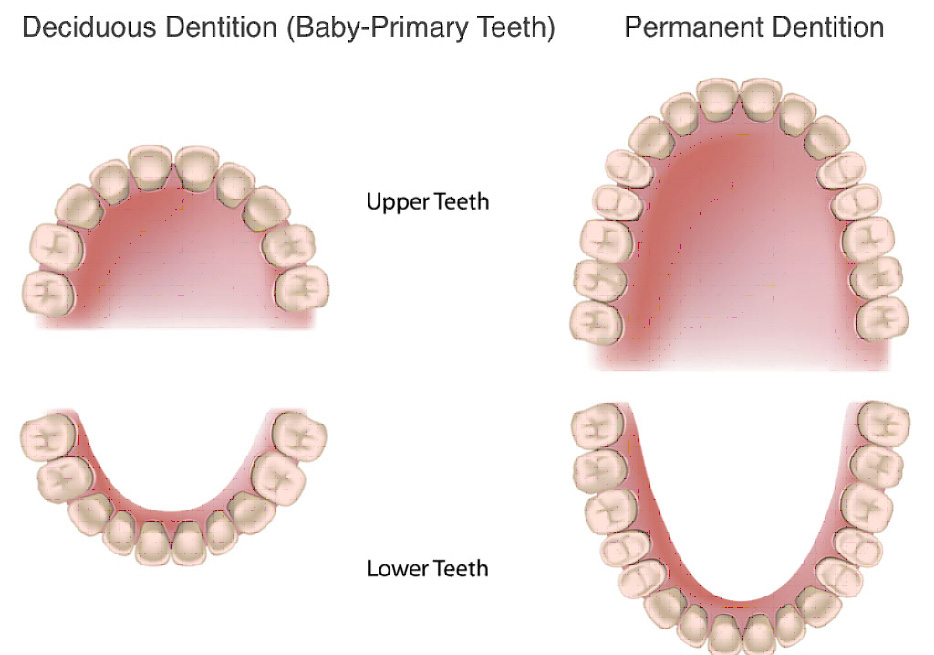
| PRIMARY DENTITION | PERMANENT DENTITION |
| Starts erupting at 6 months of age and upto 12 years | Starts erupting at 6 years of age and persists throughout the life |
| They are 20 in number | They are 32 in number |
| Morphological differences- crown | |
| Light in colour- milky white | Dark in colour- yellowish white |
| Mammeleons are usually absent | Mammelons are present in anterior teeth |
| Crown size is relatively small | Crown size is relatively larger in all dimensions |
| Mesiodistal dimensions are comparitively wider than cervico occlusal length | Reverse is true |
| Cusps are slender and more conical | Cuspids are less conical |
| Cervical ridges on buccal surface of molar is prominent | Not prominent. They are flat |
| Narrow occlusal table as the buccal and lingual convergence is more | Relatively wider occlusal table due to less convergence |
| Supplemental grooves are more | Supplemental grooves are less |
| Molars are bulbous with marked constriction | Less constriction at the cervical region |
| Contact areas are situated gingivally in posterior teeth | Contact areas are situated relatively occlusally in posterior teeth |
| ROOT | |
| Root trunks are smaller compared to root length. As a result furcation is towards cervical area | Furcation is towards apical area as root trunks are almost half of the root length |
| Wide divergence of roots and the roots are present out of dimensions of root trunk | Less divergence of roots and the roots are present within alveolar housing |
| Root is relatively long compared to crown size , root is very slender | Root is relatively short compared to that of primary dentition |
| Roots are narrower mesiodistally | Roots are broader mesiodistally |
| Morphology of pulp | |
| The pulp chamber is voluminous or large relative to crown size | The pulp chamber is less voluminous relative to crown size |
| Pulp horns are close to the DE junction and prone for exposure | Less close to outer surface |
| High degree of cellularity, vascularity with greater potential of repair | Less degree of cellularity, vascularity with lesser potential of repair |
| Varied pulpal anatomy | Relatively consistent pulpal anatomy |
| Accessory pulp canals are more particularly in the porous pulpal floor at the interradicular furcation area | Less no: of accessory canals |
| Histological differences | |
| Enamel on occlusal surface is uniform thickness of about 1mm and half that of permanent tooth | Variable thickness of enamel. Ranges from 2-3 mm thickness |
| The enamel at the cervical region slopes occlusally from the DE junction towards outer surface | The enamel at the cervical region slopes gingivally from the DE junction towards outer surface |
| Comparatively more thickness of dentin over the pulpal wall occlusally | Comparatively less thickness of dentin over the pulpal wall occlusally |
| Less mineralised | More mineralised and comparatively less organic matter |
| Neonatal lines are present in enamel and dentin | Neonatal lines are present in enamel of permanent first molars |
| Arch diastema or spacings is common and normal in primary dentition | Spacings are considered as malocclusion |
Related posts

April 10, 2025

April 9, 2025

April 4, 2025
