- NEED HELP? CALL US NOW
- +919995411505
- thefuturedentistry@gmail.com

Difference Between Deciduous and Permanent Teeth
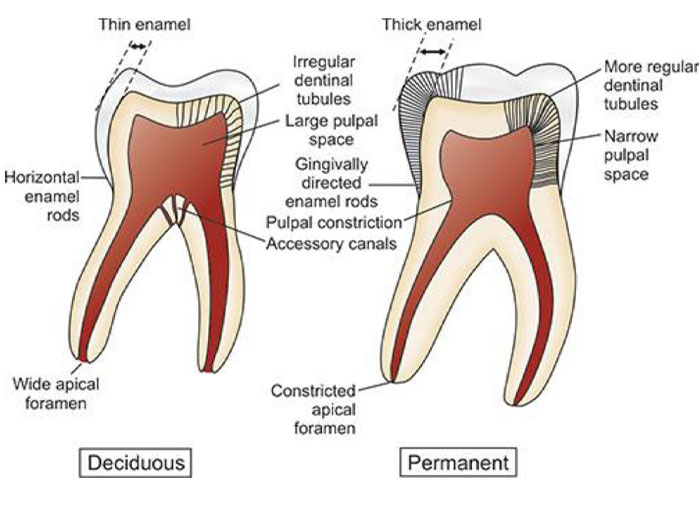
The main difference between deciduous and permanent teeth is that deciduous teeth are the temporary teeth that develop at birth and fall off at the age of 5 -6 years, while permanent teeth develop at the age of 5-6 years and remain permanent throughout life
Three periods of dentition, since the deciduous and permanent dentitions overlap in time. These periods are summarized in the following manner:
1. Primary dentition period
2. Mixed dentition period
3. Permanent dentition Period
| Deciduous teeth | Permanent teeth | |
| Eruption | about six months to two years of age | |
| No of teeth | 20 2 incisor, 1canine 2 molars |
32 2 incisor, 1canine 2 premolars,3 molars |
Eruption pattern
DECIDUOUS TOOTH
| Upper Teeth | When tooth emerges | When tooth falls out |
| Central incisor | 8 to 12 months | 6 to 7 years |
| Lateral incisor | 9 to 13 months | 7 to 8 years |
| Canine (cuspid) | 16 to 22 months | 10 to 12 years |
| First molar | 13 to 19 months | 9 to 11 years |
| Second molar | 25 to 33 months | 10 to 12 years |
| Lower Teeth | When tooth emerges | When tooth falls out |
| Central incisor | 8 to 10 months | 6 to 7 years |
| Lateral incisor | 10 to 16 months | 7 to 8 years |
| Canine (cuspid) | 17 to 23 months | 9 to 12 years |
| First molar | 14 to 18 months | 9 to 11 years |
| Second molar | 23 to 31 months | 10 to 12 years |
PERMANENT TOOTH
Upper Teeth and when tooth emerges
| Central incisor | 7 to 8 years |
| Lateral incisor | 8 to 9 years |
| Canine (cuspid) | 11 to 12 years |
| First premolar (first bicuspid) | 10 to 11 years |
| Second premolar (second bicuspid) | 10 to 12 years |
| First molar | 6 to 7 years |
| Second molar | 12 to 13 years |
| Third molar | 17 to 21 years |
Lower Teeth and when tooth emerges
| Central incisor | 6 to 7 years |
| Lateral incisor | 7 to 8 years |
| Canine (cuspid) | 9 to 10 years |
| First premolar (first bicuspid) | 10 to 12 years |
| Second premolar (second bicuspid) | 11 to 12 years |
| First molar | 6 to 7 years |
| Second molar | 11 to 13 years |
| Third molar (wisdom tooth) | 17 to 21 years |
On the basis of morphological changes
| Deciduous teeth | Permanent teeth |
| Teeth Crown: - Shorter | Bigger |
| Narrow Occlusal table | Broad Occlusal table |
| Constricted in cervical portion | Cervical constriction is not well marked. |
| Thinner enamel and dentin layers | Thick enamel and dentin layer |
| Enamel rods in the cervical area directed Occlusally | Enamel rod in the cervical area directed Gingivally |
| Broad and flat contacts | Point contacts |
| Color is usually lighter | Color is much darker. |
| Mesio-buccal cervical bulge seen in primary molars | Less prominent cervical bulge seen in permanent molars |
| Incisors have no developmental grooves or mammelons | Incisors have developmental grooves or mamelons on newly erupted teeth |
| Wide apical foramen | Constricted apical foramen |
| Mesiodistal diameter of crown is more then cervico incisal length | Cervico incisal length is more then the mesiodistal dimensio |
| Edge to edge tooh relation | Intercuspation relation |
| Develops directly from dental lamina | Develops as lingual or distal extension of dental lamina. |
| Neonatal lines are seen. | Neonatal lines is not seen in Permanent teeth except in Permanent 1st molars |
| Dentin is less mineralised | Dentin is more mineralised |
| More prone to acid attack and decay | Less prone to acid attack |
| Lamina dura relatively thick | Relatively thin |
Pulp
| Pulp Chamber Larger | Pulp Chamber smaller |
| Root Canals More Ribbon like (hour glass appearance) | Well defined with less branching |
| pulp horn are more prominent | Less prominant |
| Cellularity and Vascularity High degree | Less degree |
| Accessory Canals Present | May be Absent |
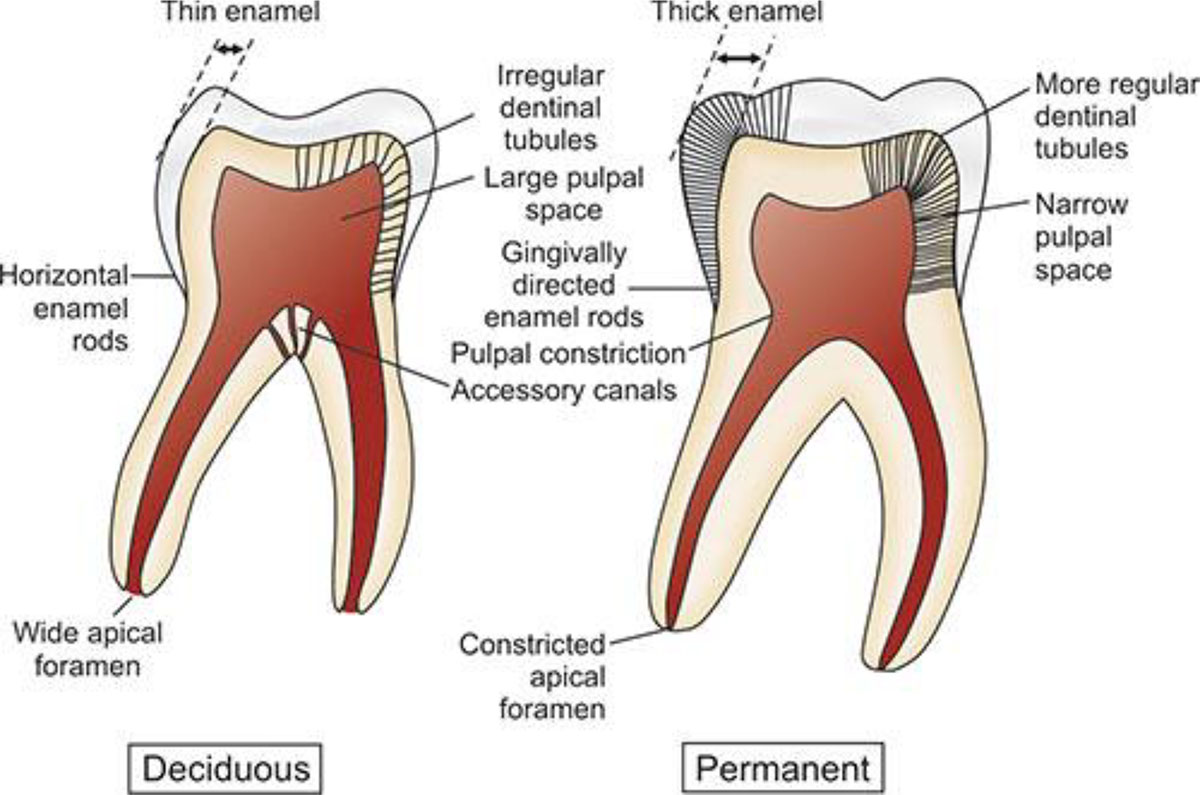
On the basis of root features
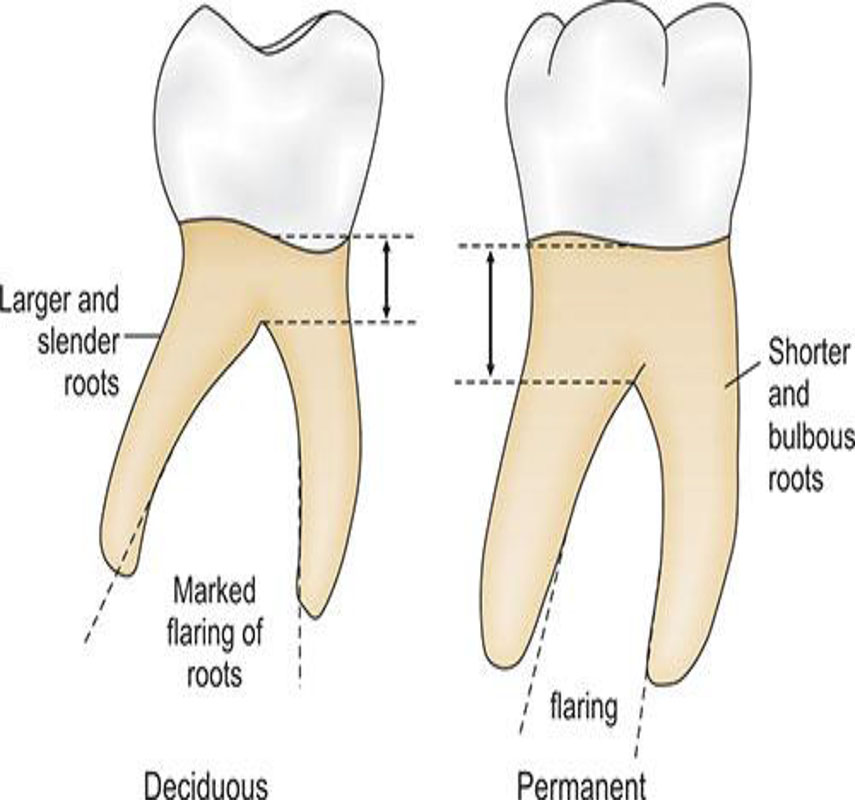
| Shape Larger, more Slender and Diverge widely | Shorter, Bulbous and non-divergent |
| Root trunk smaller | larger |
| Physiologic resorption | absent |
Histologic Differences
| Enlarged apical foramens. The abundant blood supply | Restricted, Reduced blood supply |
| Reparative dentin more | less |
| Density of innervation more | less |
| Localization of infection poor | better |
Related posts

April 10, 2025

April 9, 2025

April 4, 2025
